Personal sound therapy for tinnitus

Sound therapy,
reimagined.

Designed to target the ringing itself.

DFCRS sound therapy personalises music with the aim of making tinnitus quieter. The idea: stimulate nearby hearing nerve cells to help calm the overactive signals linked to ringing.

No card needed. Full Care programme: €99 for 12 weeks.

About 22 points less impact on daily lifeAverage score drop with DFCRS · small 3-month study · see results ↓

Practical coping lessons designed by
Hashir International Institute
Specialists in tinnitus research and care.

Your music. Made personal. Inside HearHush
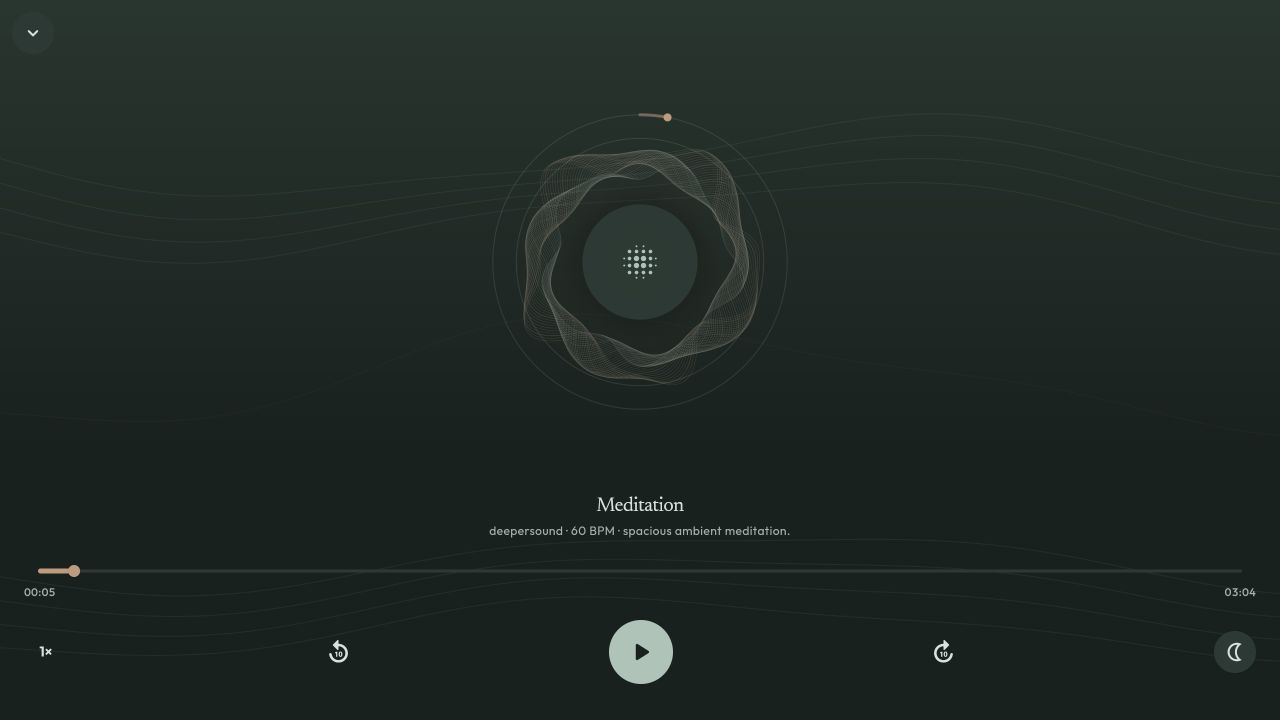
HearHush’s immersive evening player with a sound-wave visualisation, meditation track and playback controls.
Your listening space.Settle in. Make the moment yours.

Aiming for quieter tinnitusPersonalised sound therapy powered by DFCRS

Build mental resiliencePractical skills to feel more in control when tinnitus is difficult

Relief while you listenAI-powered sound masking with Sound Lab

Sound therapy driven by DFCRS technology

Give your hearing neurons
a workout.

Personalised sound. A regular routine. DFCRS adjusts music around the pitch of your ringing. Researchers propose that this stimulates nearby hearing neurons — nerve cells — which may help calm the overactivity linked to tinnitus.

The aim is to turn down the ringing itself. In the study, the DFCRS group rated their tinnitus as quieter after three months. They also reported better sleep and less impact on daily life. The study measured these experiences; it did not directly measure changes in nerve cells.

See what changed for people
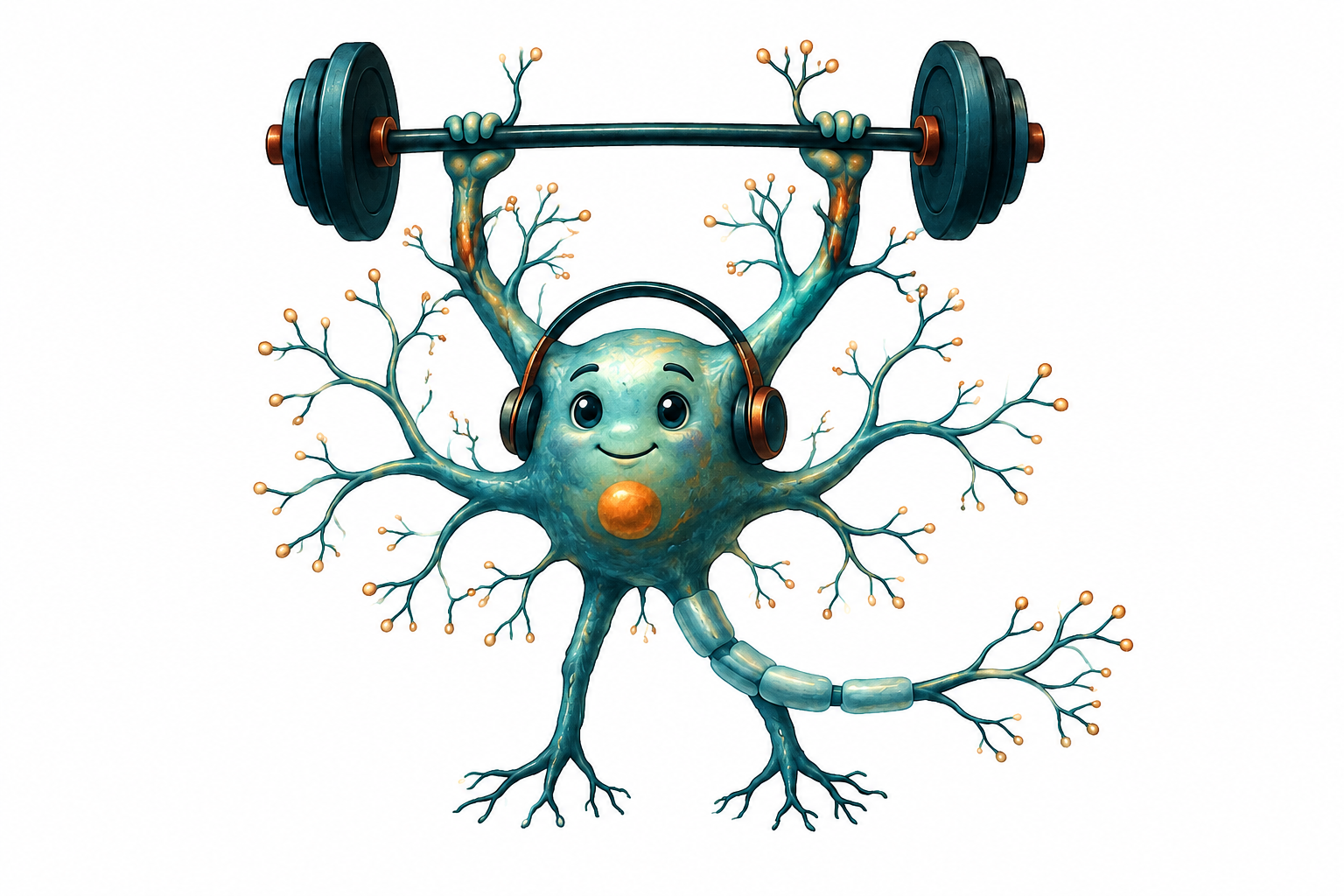
A friendly teal neuron character wearing headphones and lifting a barbell with its branching arms.
  1. 01

    Find your sound.

    Listen to a few sounds and choose the one closest to your ringing. No technical knowledge needed.

  2. 02

    Target your ringing.

    Choose music you enjoy. DFCRS adjusts the sounds around your ringing’s pitch, following the method studied by researchers.

  3. 03

    Listen. Track the change.

    Follow a listening routine and check in on your tinnitus. The study used at least two hours a day for three months.

From the idea to your own music

Your sound match.
Your personal track.

HearHush uses your sound match to adjust the music around your tinnitus pitch. Watch your track take shape, then return to it for your listening routine.

Explore your music library
DFCRS in action · condensed recording
Open video

The research behind the technology

Small study.
Big results.

Quieter ringing. Better sleep. Less disruption. In a study of 32 people, the DFCRS group reported bigger improvements in all five areas measured than the group listening to the same music without personalisation.

32 people3 months2+ hours listening a day

Less impact on everyday life

≈22points lower

The average drop in a questionnaire score measuring how much tinnitus affects daily life. Lower means less impact.

Almost no changein the group listening to the same music without personalisation
  • Ringing

    Quieter tinnitus.

    About 1.2 points lowerAverage drop on the study’s 0–10 loudness scale, compared with a rise of about 0.4 points with ordinary music.

  • Sleep

    Better nights.

    Fewer reported problems with sleep.

  • Worry

    Less anxiety.

    Lower scores for anxiety symptoms.

  • Mood

    Brighter days.

    Fewer reported symptoms of depression.

Early research on DFCRS, published in 2025. This study tested the method, not the HearHush app. Results vary. The score changes shown are approximate, read from the study’s chart.

See all the numbers and how the study worked

Researchers at Fudan University randomly assigned 32 people to two groups: 18 received DFCRS music and 14 received the same music without personalisation. Both groups listened for at least two hours a day for three months, after brief instructions from an audiologist.

DFCRS stands for Digital Frequency Customized Relieving Sound. It enhances selected frequency bands just below and above the matched tinnitus pitch. The proposed mechanism is called lateral inhibition: stimulating neighbouring hearing nerve cells may reduce activity in an overactive region. This study did not directly measure that activity or show that nerve cells were repaired.

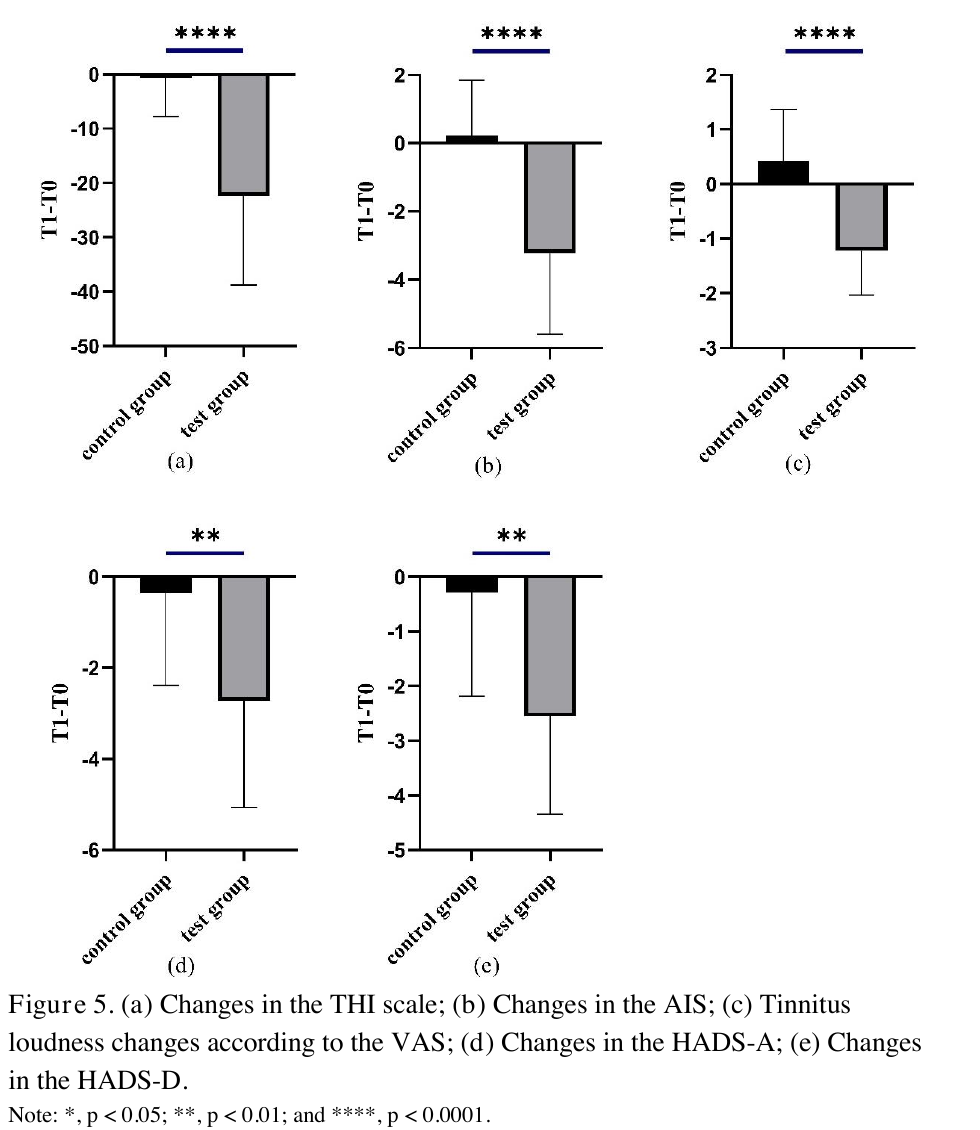
Approximate mean score changes after three months.
Negative values mean improvement on each scale.
MeasureDFCRSUnmodified
music
Reported
p-value
Tinnitus impact THI≈ −22≈ 0< 0.0001
Insomnia AIS≈ −3.2≈ +0.2< 0.0001
Perceived loudness VAS≈ −1.2≈ +0.4< 0.0001
Anxiety symptoms HADS-A≈ −2.7≈ −0.3< 0.01
Depressive symptoms HADS-D≈ −2.5≈ −0.3< 0.01

These are approximate readings of Figure 5; the paper does not list exact averages. THI measures tinnitus impact, AIS measures sleep problems, VAS measures perceived loudness, and HADS measures anxiety and depression symptoms. The p-values describe the statistical evidence for differences between the groups, not your chance of improvement.

See the original research chart
Original Figure 5: DFCRS and control mean score changes with error bars for THI, AIS, VAS, HADS-A and HADS-D. Three comparisons are marked p less than 0.0001; two are marked p less than 0.01.
Figure 5, Tang D, Wang K, Sun S. Sound & Vibration 2025;59(1):1928. © 2025 the authors, CC BY 4.0. Cropped from the published page; the figure and its caption are unchanged.

A clearer next step

You have enough to think about.
Let there be a plan.

Tired of searching for another tip? Care brings two approaches together: DFCRS sound therapy aimed at reducing the ringing, and practical lessons for handling the worry and disruption it can cause. Follow a 12-week plan and track how you’re doing.

Explore 12-week Care
  1. 01

    Understand what keeps tinnitus on your mind

    Learn how worry and attention can make ringing feel harder to ignore, with clear lessons you can follow at your own pace.

    First programme week included free
  2. 02

    Find tools you can return to

    Try practical ways to handle difficult moments. Listen to your personalised DFCRS music, or create a background sound you enjoy in Sound Lab.

  3. 03

    See the bigger picture

    Track how you feel and what you’ve tried. Look back over time to spot changes that one difficult day might hide.

Take a look inside

One place to listen,
learn and build resilience.

Find your sound, make your music personal, and explore tools for the harder days.

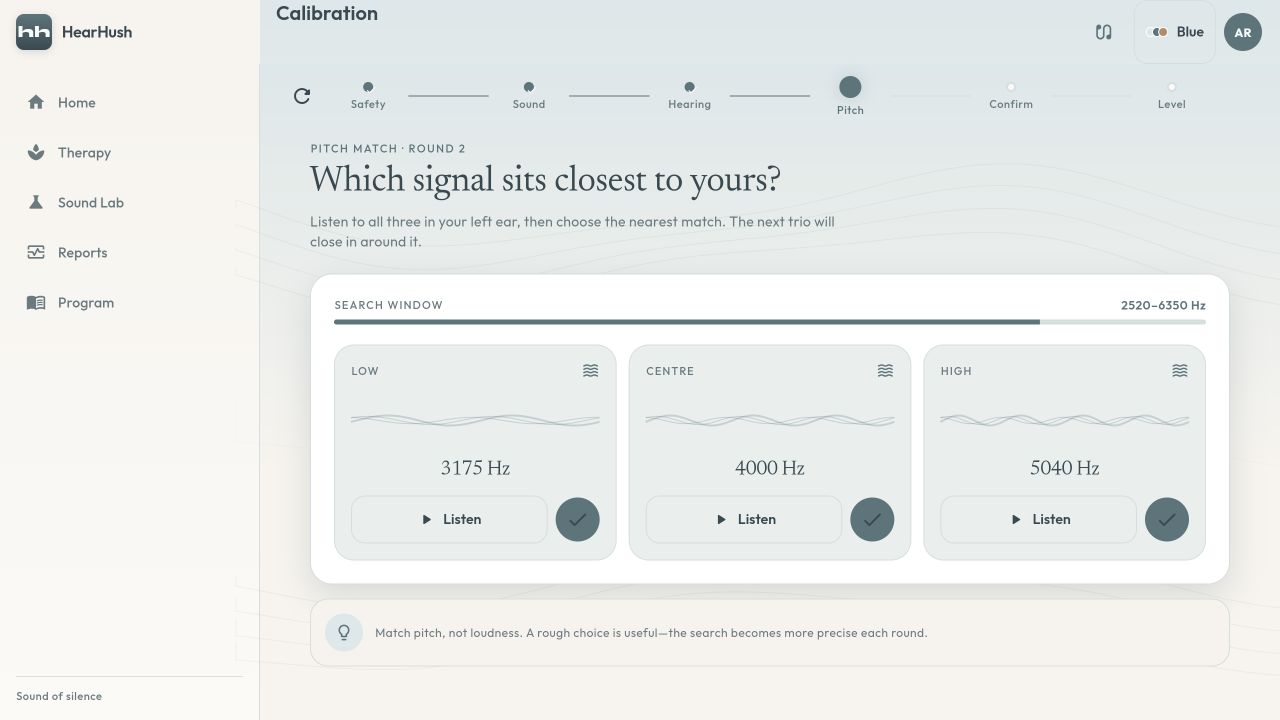
Find your sound · 8-second preview
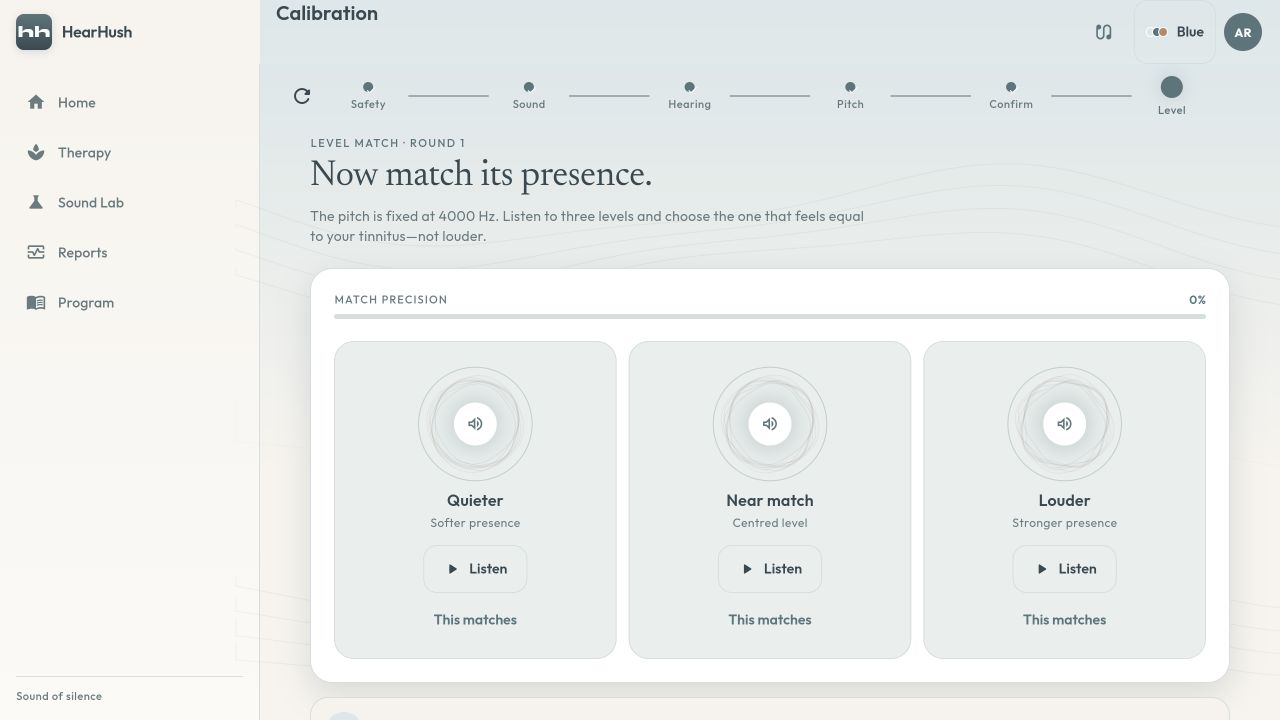
Next, fine-tune your match: Pitch Sound level
Included free

You do not need
the perfect words.

Compare familiar sound textures, then fine-tune what feels closest. Your choices create the profile used to personalise audio in Care.

This helps tailor your music; it is not a hearing test. Use headphones for the sound matching.

Create your free account
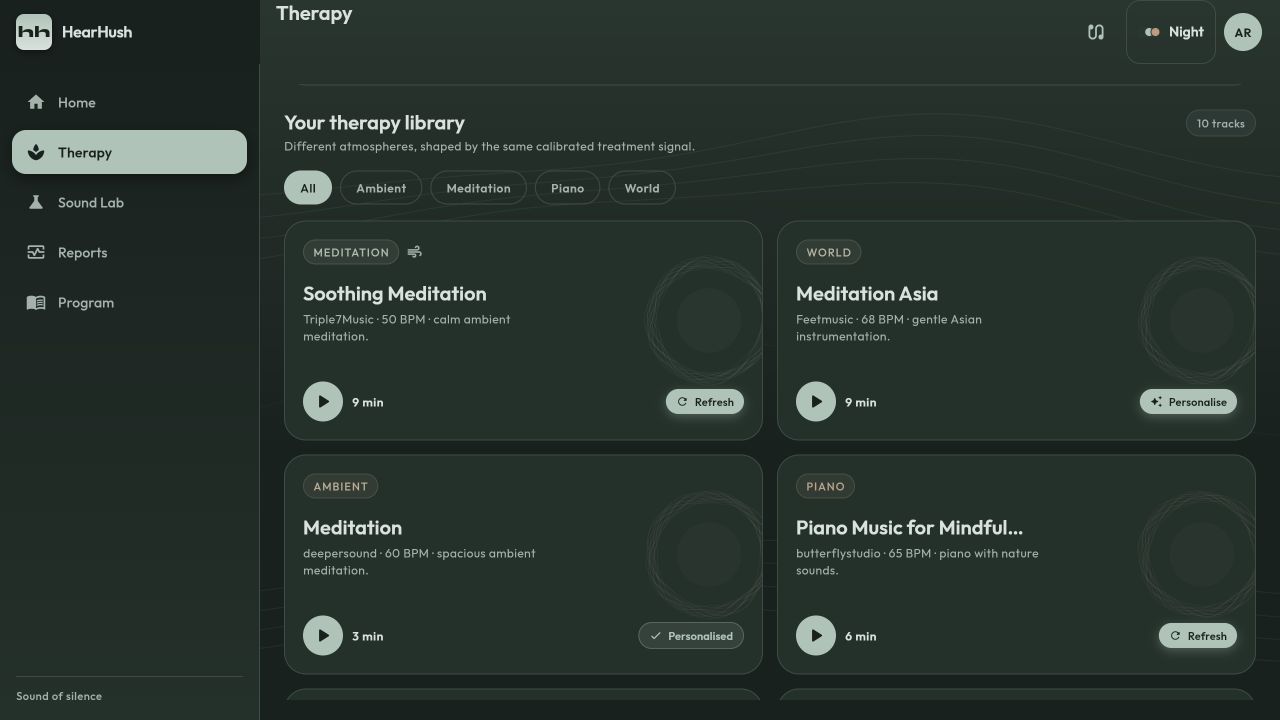
HearHush’s evening-mode therapy library with meditation, ambient and piano tracks, and personalisation controls.
Choose the music that fits your moment.
Included with Care

Make your listening
personal.

Choose a track you enjoy. DFCRS adjusts it around your tinnitus pitch, with the aim of reducing the ringing through targeted sound. Your personal version is ready to use in your listening sessions.

You control the volume and playback. Start gently and follow your clinician’s advice.

See the Care plan
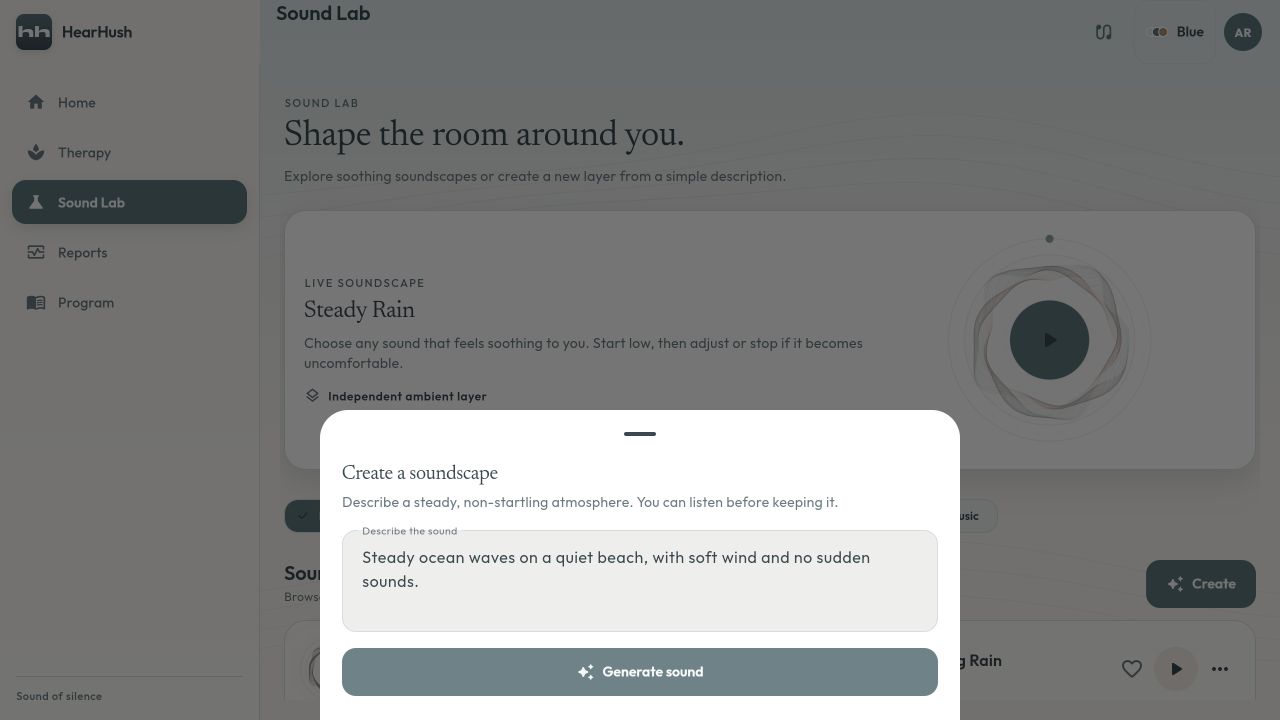
HearHush’s Create a soundscape screen, with an example ocean-waves description and a Generate sound button.
Your words. Your own atmosphere.See the sound library
Library free · AI creation with Care

Sound masking,
reimagined.

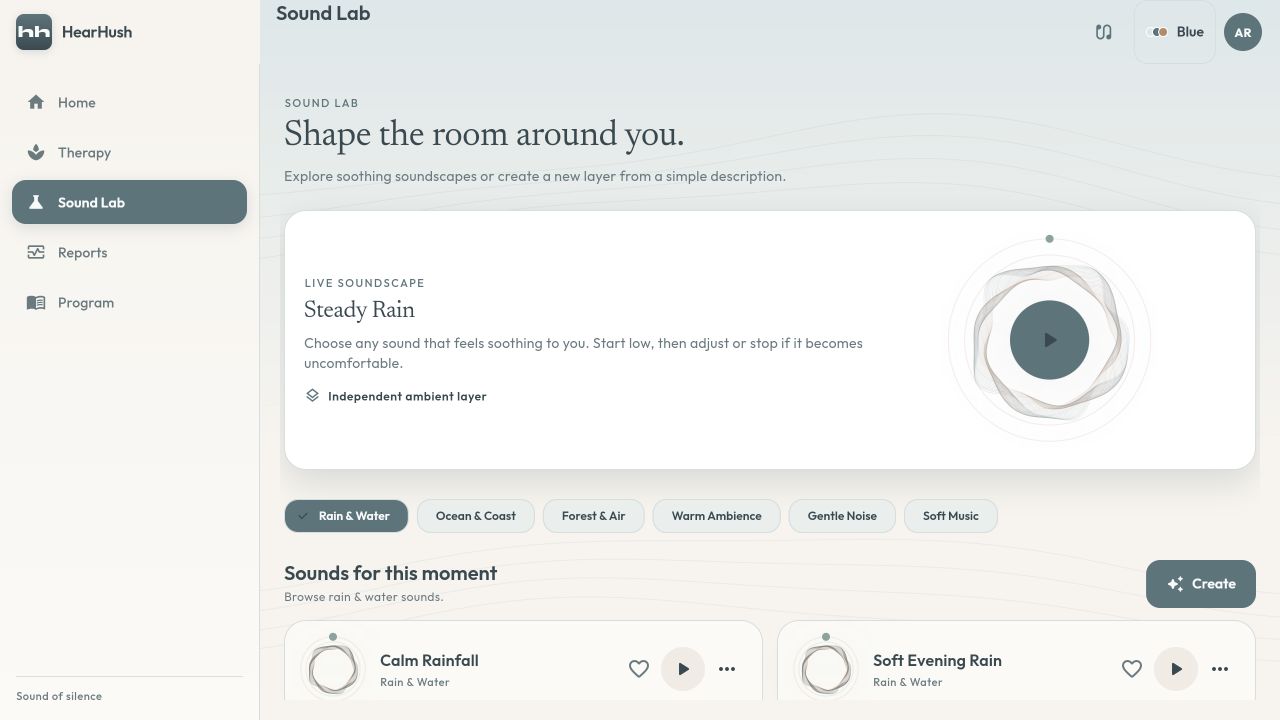
Choose a ready-made atmosphere, or describe one of your own. With Care, Sound Lab uses AI to create a soundscape from your words.

Start with a simple ideaSteady ocean waves on a quiet beach, with soft wind and no sudden sounds.

A sound that suits you can help cover the ringing and bring relief while it plays. Listen at a comfortable volume.

Compare what’s included
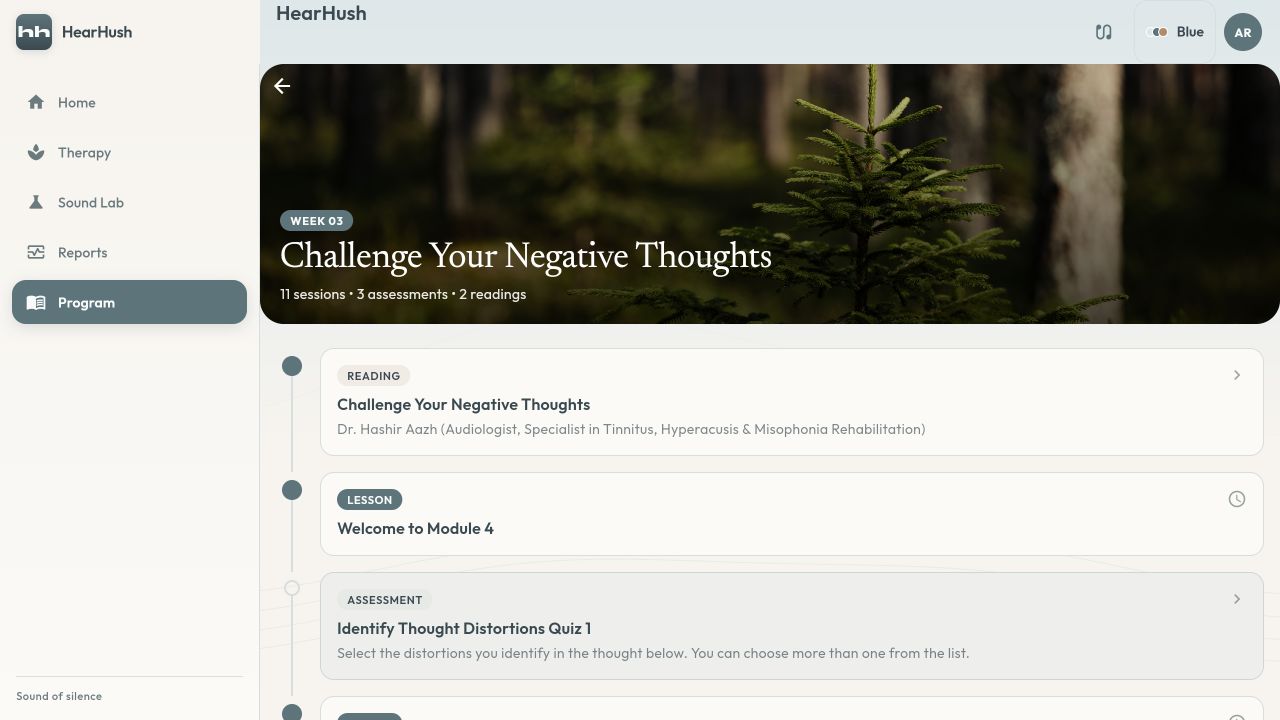
A HearHush CBT module called Challenge Your Negative Thoughts, with a specialist reading, lesson and practical assessment.
Practical lessons. A clear next step.
First programme week free

Build a more
resilient mindset.

Learn to recognise the thoughts that make tinnitus feel overwhelming, then practise a different response.

Work through guided lessons, readings and exercises designed by Hashir International Institute. Pause when you need to and return at your own pace.

Explore the programme

The programme behind Care

Specialist knowledge.
Everyday practice.

HearHush×HashirInternational Institute

Your coping lessons were developed by Dr Hashir Aazh, a tinnitus specialist, and licensed from Hashir International Institute.

They use cognitive behavioural therapy, or CBT: practical exercises to work on the worry, thoughts and habits that can make tinnitus harder to live with. Follow the lessons at your own pace, alongside your personal sound therapy.

Care is self-guided. Individual clinician appointments are not included, and results vary.

Meet the programme’s creator
Why does Care include coping lessons?

NICE includes tinnitus-focused CBT in its recommendations for persistent tinnitus-related distress, with professional involvement. This supports the approach; it is not an endorsement or a clinical validation of HearHush.

Care brings together two distinct approaches: frequency-specific sound personalisation using DFCRS, and practical CBT skills for coping with tinnitus. The DFCRS study tested personalised music, not the combined HearHush programme.

Start with your first week free

Three ways to take control.
One complete programme.

Personalised sound therapy, practical coping skills and your own AI Sound Lab. Try the first week free. No card needed to start.

Get to know HearHush

Free

€0no expiry

Start a routine and see whether the programme feels right for you.

  • First week of practical coping lessons
  • Tinnitus and wellbeing check-ins
  • Find and save your tinnitus sound match
  • Sound Lab library and playback
Try the first week free

Free access does not automatically become paid.

The complete programme

Care 12 weeks

€99one payment

That’s €8.25 per week, paid once.

Personal sound therapy, practical coping skills and AI sound creation. Together in one plan.

  • Everything in Free
  • Full 12-week coping programmeDesigned by Hashir International Institute.
  • DFCRS personalised sound therapySound therapy tailored to your tinnitus.
  • Your own AI Sound LabDescribe a soundscape. Create it. Make it part of your routine.
  • Complete progress reportsYour check-ins and progress, together.
Open HearHush to choose Care

Sign in or create an account, then choose Care in Membership. Care does not auto-renew.

Prices shown are for web access. Google Play displays its local price before payment.

Before you begin

A few things
worth knowing.

Have a question about the app?
Email support ↗

What happens when I start free?

Create an account and follow the setup. Try the first week of coping lessons, find your tinnitus sound match, explore the Sound Lab library and check in on how you feel. You only pay if you choose Care. Personalised DFCRS music is included in Care.

How is this different from a sound app?

DFCRS aims to reduce how loud tinnitus feels by using personalised sound to stimulate nearby hearing nerve cells. That is the researchers’ proposed explanation for how it works. Care pairs this sound therapy with 12 weeks of practical lessons for the worry and disruption tinnitus can cause.

Will it make my tinnitus go away?

DFCRS aims to make the ringing quieter. The paper discusses the possibility of reducing or even eliminating the perception of tinnitus, but it does not report how many participants became tinnitus-free. It reports an average reduction in perceived loudness after three months. HearHush cannot promise silence or a cure.

How is Sound Lab different from DFCRS?

Sound Lab helps you find a sound that covers the ringing while you listen. Choose from its library, or describe what you want and use Care’s AI to create a custom soundscape. This is sound masking: it can offer relief during playback, and the effect varies from person to person.

DFCRS personalises sound around your matched tinnitus pitch as part of a regular listening programme. The published DFCRS results are separate from Sound Lab’s AI sound creation.

How sound masking can help
How long do I listen to DFCRS music?

The study used regular listening sessions: at least two hours a day for three months. The aim is to reduce the ringing itself. The paper did not test how long improvements lasted after people stopped the routine, so it cannot tell us when listening can end.

Is a therapist included?

No. Care is a self-guided programme. Individual appointments and ongoing clinical supervision are not included. Continue to follow the advice of your healthcare professional.

How much time should I set aside?

Lessons vary in length, and you can pause and pick up where you left off. Finding your tinnitus sound match usually takes about 5–10 minutes. The app’s sound therapy plan aims for two hours of listening a day, as in the study. Start gently and follow your clinician’s advice.

What happens after the 12 weeks?

Care ends without automatically renewing. Free features remain available. If you want continued access to the full programme and paid tools, you can choose Maintenance for €59 per year. Maintenance renews annually until cancelled.

Should I see a clinician first?

HearHush is for adults aged 18 and over and does not replace a medical assessment. New or changing tinnitus should be discussed with a clinician. See the medical guidance below for symptoms that need prompt attention.

When to seek medical care ↓

You can start small

One useful step today.
More room for tomorrow.

Start your first week of coping lessons free.
Explore a Care plan with sound therapy aimed at quieter tinnitus.

Try the first week free

No card needed. No automatic upgrade.

Inside HearHush